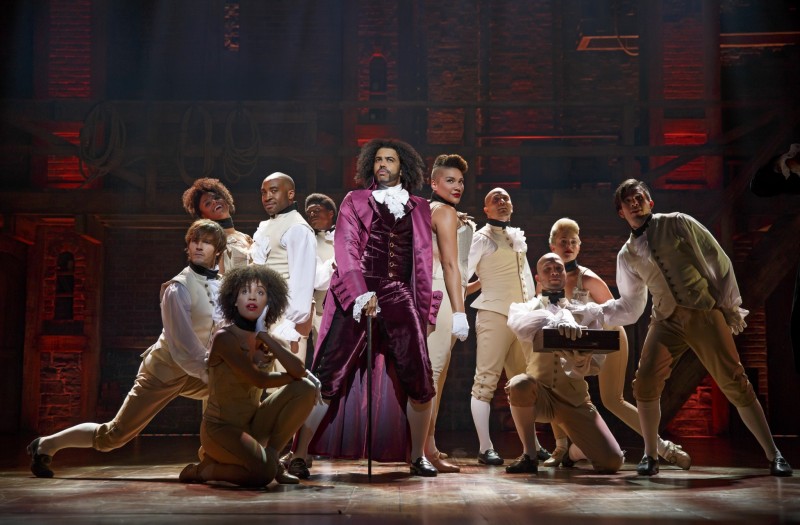
Hamilton is a musical that took the musical genre out of Broadway and opened questions in Americans; white, black, immigrants, and other genders than men. The frequent critics of this play are focused on the casting of performers of color playing white founders, the music, and the leak of real people of color in the play like slaves or servants. The use of people of color in the play humanizes white founders. It brings them close to the “other” America, the America of minorities like me that knew nothing about Hamilton. I discovered a fantastic thing about the independence age through Miranda’s play.
The idea of a Black Jefferson or a Latin Hamilton is revolutionary and provocative at the same time; actors are bringing back people that supported slavery and had some slaves under their control. The performers and the music make “race” present during the play; as the historian Lyra D. Monteiro contributes in the book Historians on Hamilton, “race is, in some ways, front and center of this play, as the founding fathers are blacks and Latino men.” (60) On the same page, Monteiro makes references to the Caribbean origins of Hamilton and Miranda as well, even the actors who play Hamilton a couple of days at weeks instead of Miranda is Porto Rican as well. In the counterpart part, white historians critic the casting because “they are dressing up like slave traders, and it is not Halloween.” (60) I think one of its goals of Miranda was to provoke the extreme right historians with something different; take them out of their comfort zone. This play was released during the Obama administration, and some critics, including Chernow, the writer of Hamilton’s biography, highlighted Obama’s influence on the cast and the play’s success. Miranda knew how to mix his Latin roots with hip-hop; he could switch codes from the Latin Washington Heights to the American part. Miranda uses his experience to create a “conscious cast.” For “un-white” the history and get close to the ordinary people. One of his brilliant proposals is to bring Lafayette, Burr, Hamilton, Mulligan, and others to the tavern like a Sunday football game; probably, people identify with that scene and the location. Miranda and the casting bring the fathers of this nation into the people’s life.
Hip-hop is part of the underground culture of music that talks (used to) about the social problems in the Bronx, an immigrant neighborhood. The musical gets that underground feeling with the incorporation of hip-hop and other popular rhythms. Hip-hop has made the messages present in people’s minds for a long time. The music of this play is rhythms coming from Latin, Caribbean, and Afro-American cultures. Also, this music was considered, during its beginning, as music from ghettos and poor neighborhoods where violence and social problems were present. Hip-hop and similar rhythms in this musical can be considered revolutionaries and underground. The music provides more credibility to the minorities and their speeches; furthermore, the Afro tunes challenge the white male superiority portrayed by King George. In some way, white supremacy is still ruling our days, but each time turns weak, soft, and less authoritarian. Immigrants and people of color are winning more room; we get the job done. King George’s speech sounds like he is waiting for his next partner to have fun, but no one will be at the level of George Washington. Hip Hop changed the founders of this country into famous heroes or popular figures; musicals are related to elite people, and the intelligent incorporation of Hip-hop increased the public curiosity, a hero for this multiracial country. Music gives voice to female characters that suffer another kind of slavery; the women’s marriage “covertures” through Schuyler’s sister’s experiences. Angelica loves Hamilton, but she can’t marry him because of her older sister’s duties; at that time, women didn’t have legal independence; they were a “product” like a cow to pass from father to husband. (104) Women, as slaves of their own families, couldn’t vote, make contracts, or be sued. Women are more than a product; they played a vital role in the history of this nation and the world. The revolution of that era brought hope to females, “Look around / how lucky we are to be alive now! / History is happening.” The musical makes us look back at the past and rethink different events and characters that contributed to creating this country.
The play challenges racial stereotypes, but it doesn’t complete the expectations of many critics because enslaved people do have not to voice in the play. Historians criticize the absence of enslaved people even in the number of “The Room Where It Happens” that wholly erased the enslaved people at would have been serving dinner (64) even though hundreds of Black and Brown people fought in the war (for both sides). History doesn’t talk about them, and probably people may be talking more about the black actors playing Jefferson than the absence of people of color in our history; they were present. Romano and Potter suggest that Hamilton had a complicated (dualist) relationship with slavery like other founders. Historians critic the founder’s public anti-slaves’ posture but living a private white-dominant life; with enslaved people. Behind these cool guys, there is a message about racism and immigration, Hamilton is not a hero, neither Jefferson nor Franklyn, maybe Washington, but they are presented as people living in slavery times, Jefferson said in the Cabinet Battle #2, “And stand with them / If they fought against oppressors / and revolution is messy / but now is the time to stand! / stand with our brothers / as they fight against tyranny.” Ambiguously, Jefferson supported slavery in the south and was fighting for his nation’s freedom. Jefferson confirms in the song Washington On Your Side, singing in chorus with Aaron Burr and James Madison, “Somebody has to stand up for the South!” The same Jefferson who ran for president after Washington resigned after seeing a war on the horizon. To conclude this essay, I consider that this musical opened an excellent opportunity to talk about race, social problems, gender, our heroes, our money, our system, and why not, about the future of the next generations, as Lin Miranda said, this is not a musical for this time, it is created for challenge future generations.
Race and Slavery in Hamilton
 Vera Academic Research